Schema Markup: How Bots Understand Your Website
-
3 min
Schema markup is how bots understand what your page and your business are. It won't guarantee AI citations (our GEO post covers the bigger picture), but it replaces guessing with labels. Here's what it does, where it stops, and why it's still worth understanding.
What does a bot see on your page?
About half of crawled pages carry some structured data: 51.25% of 2.4 billion in the October 2024 Common Crawl (Web Data Commons). That measures presence, not quality.
A bot sees text, not meaning. Is "Berlin" an address or a product line? Is "Web hosting" a service or a blog topic? Without labels, it guesses.

What is schema markup, in plain words?
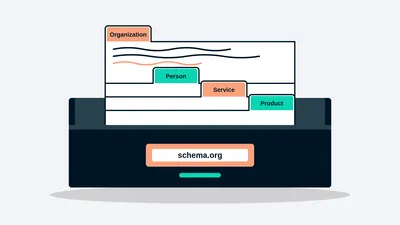
Schema markup is a shared vocabulary, usually written as JSON-LD code that visitors never see, for labelling what a page is about. Google's stated goal in 2012 was to understand "things, not strings" (Google, 2012). Think of labels on drawers: nobody has to open every drawer and guess.
Each thing gets an ID, written @id, like an ID card number: the same number always means the same company. Google's Organization documentation says such markup helps it disambiguate your organisation in search results. Person and Service markup has no Google rich result, though.
Does schema markup help with AI search? An honest look
Not in a way anyone has shown. The evidence says "helps machines understand", not "gets you cited".
-
Google needs nothing special
No special markup is required for its AI features (AI features page, December 2025; AI optimization guide, May 2026). -
Microsoft says it helps
Bing's lead said at SMX Munich in March 2025 that schema helps its models understand content (Search Engine Roundtable). That's reported speech, not documentation. -
A large test found no lift
Ahrefs added JSON-LD to 1,885 pages in May 2026 and measured no attributable change in AI citations (AI Mode +2.4%, ChatGPT +2.2%, AI Overviews -4.6%). The 53% of AI-cited pages with schema is a correlation (Ahrefs). -
Classic search still uses it
Rich results and clearer company identity, readable by any bot.
Our reading: cheap clarity, not a citation lever. It must match the visible page.
Why does hand-written schema go stale?
Google keeps retiring rich-result types. The FAQ rich result stopped on 7 May 2026 (Google), after seven other types were phased out in June 2025 (Google Search Central).
Your own site drifts too. A price changes, a colleague leaves, a page moves. The page gets updated, the code block doesn't. In our experience, markup is right on launch day and drifts from then on.
What happens when it grows into connected entities?
Real sites carry dozens of labels pointing at each other. Ours holds 43 entities and 99 relationships in the English view: a staff directory plus an org chart, for everything the site talks about.
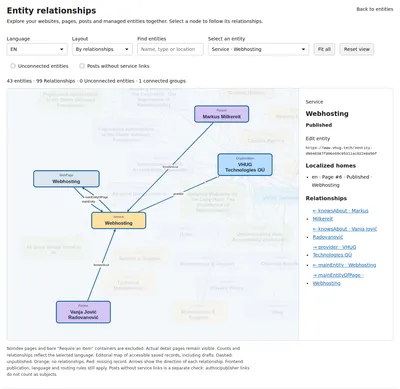
By hand, that picture lives in someone's head.
What should you do about schema markup?
Start small and keep it true.
-
Label what's visible
Describe only what visitors can read. -
Start with the basics
Organisation, authors, main services, each with a stable ID. -
Re-check when content changes
New price or team member: update the labels in the same step. -
Don't expect citations
Treat any AI gain as a bonus.
Where our extension fits in
If your site runs on Contao, we built an extension for this: it keeps entities and relations in one place. See the extension page and the announcement, or find it in the Contao extension store or on Packagist.
Frequently asked questions about schema markup
-
No. Google says its AI features need no special markup. Schema still gives every bot clean labels.
-
Structured data is the general term. Schema.org is the shared vocabulary of labels. JSON-LD is the code format most sites use to write them.
-
It can. Labels that don't match the visible page are misleading, and search engines may ignore them.

Markus Milkereit
Founder & Lead Developer
Writes about accessibility, maintainable front-ends and the unglamarous parts of running a website well.