Label AI-Generated Images on Your Website: Art. 50 Guide
-
3 min

Since 2 August 2026, the deployer duties of Art. 50 of the EU AI Act apply: if you publish realistic AI-generated images or videos, you must disclose that they are artificial. Here is what that means for your website, plus where our Contao extension fits in.
In brief
- The duty sits with those who publish AI content.
- It mostly affects realistic AI images and videos that could pass for real people, places or events.
- Disclosure has to be visible: metadata alone doesn't count.
Not legal advice: a practical overview from a Contao team. For binding statements, talk to a lawyer.
What does Article 50 of the AI Act require from website owners?
Since 2 August 2026, deployers must disclose deepfakes: AI-generated or AI-manipulated content that resembles existing persons, objects, places or events and would falsely appear authentic (Art. 50(4), Art. 3(60); European Commission, FAQ on Art. 50, updated 24 July 2026).
You count as a deployer if you use an AI system professionally, for example to generate an image for your website.
AI-generated text follows its own rule, so this article covers images and videos only. The Commission's July 2026 guidelines cover edge cases (guidelines page).
The grace period until 2 December 2026 covers only the providers' marking and detection duty under Art. 50(2) for systems placed on the market before 2 August 2026 (Digital Omnibus on AI, Regulation (EU) 2026/1744), so your duties apply now. Earlier content needn't be relabelled (Commission FAQ). Breaches can cost up to EUR 15 million or 3% of total worldwide turnover, with proportionality for SMEs and small mid-cap companies (Commission FAQ).
Which AI-generated images do you need to label on your website?
Realistic people, places or events are the core case. Abstract, illustrative or fantasy images don't pass as real photographs, so they usually aren't deepfakes. That's our reading, and borderline cases haven't been tested in court yet.
Creative, artistic, satirical or fictional works need only a light disclosure that doesn't spoil the work. Keep a record of which files on your site contain AI.
How do you disclose AI content so that it counts?
The disclosure must reach people at the latest at their first exposure to the content, and be clear, distinguishable and perceivable without specific technical tools, for example through a visible label (Commission FAQ).
Machine-readable marks alone, such as metadata or watermarks, don't satisfy the deployer duty.
The Commission offers EU icons for AI content (official EU icons page), free to use but no proof of compliance on their own.
What is the Contao extension AI Label, and what doesn't it do?
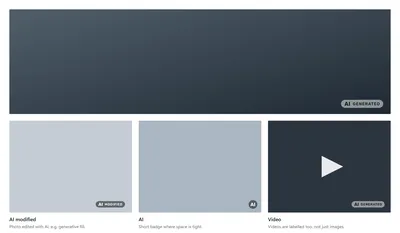
Our Contao extension sets "AI generated", "AI modified" or "AI" once per image or video in the file manager, and the visible label appears wherever the file is used. It writes no machine-readable marking and doesn't make a website "compliant". Details are on the AI Label extension page.
Conclusion: when in doubt, label it
When in doubt, a visible label is the pragmatic answer, and the legal assessment stays with you and your adviser.
Want to try Contao AI Label?
All details and updates are on the extension page.
Frequently asked questions about labelling AI content under Art. 50
-
Yes. The duties attach to your role as a deployer, not to company size. Proportionality can be taken into account for SMEs and small mid-cap companies when it comes to penalties.
-
No. The duty covers content that resembles existing persons, objects, places or events and would falsely appear authentic. Abstract illustrations are usually fine.
-
Not for deployers. The disclosure must be perceivable without specific technical tools, so a visitor has to be able to see it. Machine-readable marking is mainly the providers' duty under Art. 50(2).
-
No. The grace period covers only the providers' marking and detection duty under Art. 50(2), for systems placed on the market before 2 August 2026. Deployer duties apply since 2 August 2026.